
Right To Information (RTI)
What is RTI?
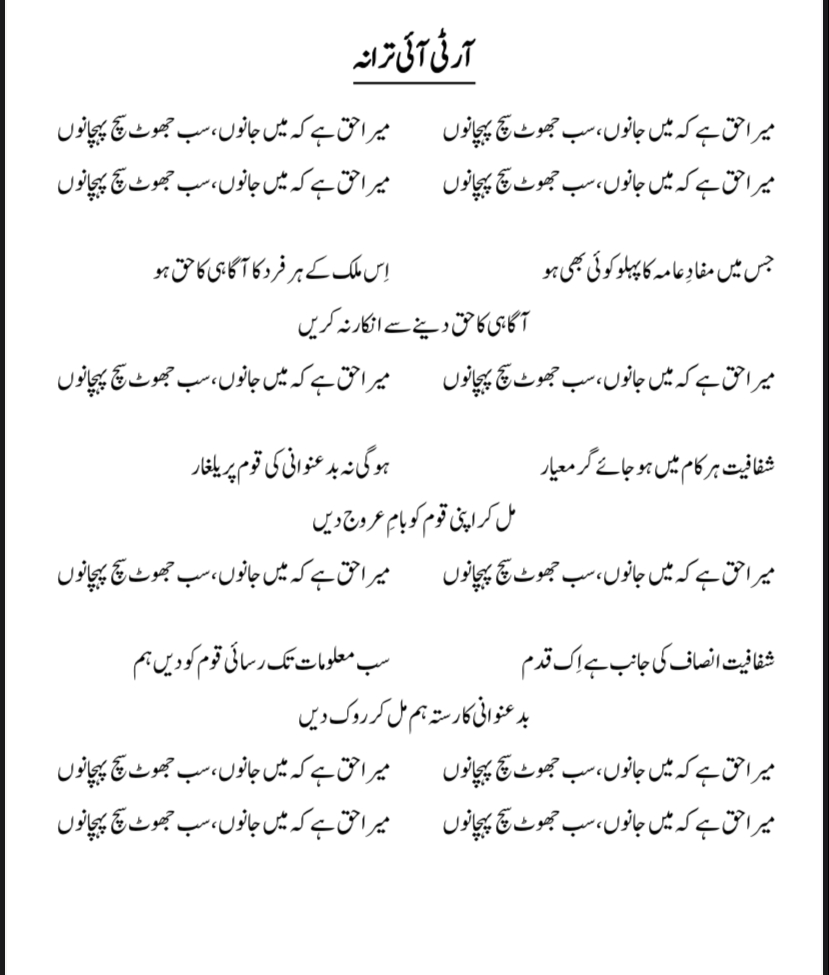
RTI is a world-renowned concept that stands for “Right to Information”. It is presently enforced as a legal framework in almost 125 countries either under the title of RTI or FOI (Freedom of Information), both being interchangeable for each other. It is based on premise that citizens being taxpayers are the owners of state machinery and information held by public bodies. It is believed that with public information about each order or use of public funds, leads to participatory governance in a real democracy.
In Pakistan, the foundation of RTI was laid with the insertion of Article 19-A in the Constitution in 2010. It acknowledged the Right to information as a fundamental right of citizens and any citizen can have access to any public information of public importance held by any public body. RTI boosts transparency, accountability, the efficiency of public functionaries, elimination of corruption, and obviously improves public services.
How RTI contributes to good governance?
When a citizen gets information about any public service or use of public funds, he obviously becomes more effective in his day-to-day functions. It also provides an opportunity for citizens to comment upon the performance & policies of public bodies which leads to vibrant public opinion. Since public opinion plays a pivotal role in national politics so ultimately the overall governance necessarily improves. It is because general ignorance of the public allows public functionaries for that matter government at the top level to indulge in policies that are not in the interest of the public at large. In short, RTI is a recipe for the elimination of corruption, efficiency of public functionaries, and good governance.
The Government also benefits from RTI as public debate makes it aware of the gaps and weaknesses in the function of public bodies as such provides an opportunity to address said issues. In this view of the matter, RTI is beneficial to major stakeholders including public and public bodies.
The vision of the Deputy Commissioner about RTI?
Deputy Commissioner DGKhan considers that having an informed society and holding public functionaries accountable to citizens is the paramount consideration of RTI. DC DGKhan also considers that times have changed and secrecy and distance from the public are no longer compatible with democracy and that role of a Deputy Commissioner is central in a district to ensure improved public services. In order to implement his vision he has taken the following immediate actions in collaboration with the Punjab Information Commission is a regulator of RTI law.
Two modes of disclosure of information by DC Office;
I. Proactive Mode of Disclosure (Sec-4 of the Act);
The act provides 13 kinds of basic information regarding each public body which need to be disclosed proactively or voluntarily through official websites. Such information is the introduction of Rules, Regulations and Laws, the Directory of all Officers with their function and powers and detail of all public services rendered by a public body. Such updated information must reflect all the time on official website to facilitate citizens looking for any service from the public body.
The act provides 13 kinds of basic information regarding each public body that needs to be disclosed proactively or voluntarily through official websites. Such information is the introduction of Rules, Regulations, and Laws, the Directory of all Officers with their function and powers, and detail of all public services rendered by a public body. Such updated information must reflect all the time on the official website to facilitate citizens looking for any service from the public body.
II. Re-active Mode of Disclosure (Sec-10 of the Act)
Any information that is not covered under Sec-4 of the Act and hence not proactively disclosed can be retrieved by filling RTI Application to the PIO designated u/s 7 of the Act. A PIO (Public Information Officer) is officially assigned the task of conduct of RTI business by dealing with all RTI Applications. DC DGKhan ensures that PIO for his office and all PIOs designated for all other offices under his administrative control must be well-versed with RTI law and preferably trained by Punjab Information Commission to deliver RTI services. The list of officers presently designated as PIOs is as under;
DC Office
ADC (R)
ADC (G)
ADC (F&P)
AC DGKhan
AC Kotchutta
AC Taunsa
The procedure for Processing RTI Applications?
RTI Application can be filed either on plain paper or prescribed performa. DC office DGKhan has already adopted the performa used by Punjab Information Commission. A view of such an application is as under;
Access to Information - Process Flow
A Citizen is required to disclose the following information while filling RTI Application:
- Copy of Identity Card
- Mobile Contact No
- Email Address
- Mailing Address
An applicant is under obligation to provide necessary detail and adequate description of the requisite information/document;
An applicant is not bound to explain the reason to have access to some particular information;
PIO subject to making necessary entries in RTI Register issues acknowledgment receipt to the applicant;
Any PIO working under the administrative control of DC DGKhan, first of all, determines whether the requisite information/document is really held by the office. In case it is so held, he evaluates the requisite information w.r.t 8 exemptions provided u/s 13 (1) of the RTI Act. If the information is not exempted under any of the 8 sub-clauses then dispatch the certified copy/copies of information at the given address of the complainant at state expenses taking the same as a statutory obligation.
Time Limit:
Although the usual limit for providing/disclosing the information is 14 working days yet in case of some complications the said limit extends to a maximum of 28 days in such cases PIO of DC Office DGKhan informs the citizen about the cause of the delay and tentative date of disclosure.
In case any information is found exempted under any of the 8 sub-clauses of Sec-13 (1), the PIO of the DC office in DGKhan passes a Speaking Order and dispatches its copy at the given address of the complainant.
All PIOs in the DC office DGKhan keep efficient liaison with Punjab Information Commission for guidance and also appear for hearing when citizen file an RTI Complaint (Appeal) before the Commission.
Citizens are also advised to visit the RTI Punjab Commission website and fill out the online application form to directly submit the application to Commission.